


Technique: FUE
Approach: Doctor-led Procedure
Surgeons: GMC, ISHRS Registered
Cost: £4,500 – £6,500
Grafts: Based on patient’s hair loss
Crown Hair Transplants




GMC-Registered Surgeons
Every procedure at our Manchester clinic is performed by a GMC-registered surgeon
Manchester City Centre
Based in central Manchester and easily accessible from across the North West
Free Consultation Available
An honest assessment of your hair loss and what is realistically achievable, no obligation to proceed
Quality Over Volume
Our surgeons treat one patient per day so every extraction and placement receives their full attention
Crown Hair Transplant Manchester
A crown hair transplant is a medical procedure that looks to treat hair thinning and hair loss on the top (crown) of the head. Hair is taken from the back and sides of the head (donor area) and implanted into the crown area on the top of the head. Crown Hair Transplants typically cost between £5,000 and £6,500. Book your free consultation today!
What is the Crown Hair Transplant?
 Crown hair transplants are a common surgical procedure that increases the density and thickness of the hair on the crown of the head. This is done by extracting hair follicles from the back and sides of your head (donor area) and implanting them into your crown (recipient area).
Crown surgeries are a viable option for men who are suffering from medium to severe cases of a condition called male pattern baldness. In comparison to other hair loss treatments that may not be suitable for larger cases (such as minoxidil or PRP therapy), the crown hair transplant is suitable for all patients.
A crown hair transplant is a long-term solution to hair loss on the top of the head. By having surgery and maintaining a great aftercare routine, your transplanted hair will grow for many years after the surgery, hiding any signs of hair loss.
At the Manchester Hair Transplant Clinic, all hair transplant procedures are performed by qualified hair transplant surgeons in a CQC-registered clinic. At the Manchester Clinic, our surgeons are Dr. Mohammed Ditta (GMC: 7084372) and Dr. Aziz Elgindi (GMC: 7450896).
Make the best investment in yourself and find out more about how we can help eliminate hair loss for good!
How Does a Crown Hair Transplant Work?
At the Manchester hair transplant clinic, most crown procedures are performed using the FUE hair transplant method. Although, DHI (Direct Hair Implantation) may be recommended in some circumstances.
As with any hair transplant procedure, the aim is to take hair follicles that are resistant to hair loss from the back and sides of the head (donor area) and implant these into areas that need them (recipient site). In this instance, the recipient site is the crown area, which is located on the top of the head.
Initial Consultation and Anaesthesia
On the day of your procedure, you will first have a pre-surgery consultation. During this, our doctor will walk you through the surgical procedure, introduce you to the surgical team, and answer any questions you may have.
From here, we will plan and design your new hairline with precision, enabling you to make any final adjustments/requests before the surgery takes place. Then, you will be given a small amount of local anaesthesia to numb the extraction and implantation site.
So, let’s walk you through each step of a FUE crown hair transplant surgery in Manchester.
Extraction Phase
During the extraction phase, viable hair follicles are taken from the donor area on the back and sides of your hair. The surgeon and team of technicians will extract the exact number of grafts needed to provide you with a natural-looking and full result. The exact number of grafts does depend on the size of the surface area of each patient’s crown hair loss. However, most patients usually have between 1,800 and 2,500 grafts taken from the donor area.
During this phase, each hair follicle will be counted by one of the technicians and will be categorised as a “single”, “double”, or “triple” graft. Each graft has a designated number of hair follicles within it. The more hair follicles, the larger the graft and the more density it provides the patient with once implanted.
Single and double hair grafts tend to be placed further forward in the crown area. This enables the surgeon to seamlessly blend the donor hair into the existing hairline and mid-section. Triples provide the most density and are implanted into the baldest part of the crown.
Incision Phase
After the extraction and graft counting has taken place, the incision phase will take place. At this point, the surgeon will begin to make many small incisions into the crown area to enable the transplanted hair to be implanted. The key to it is for the incisions to mimic the direction of growth (which is typically circular in nature) around the crown so that when the hairs get implanted in, they will grow in that direction making the result look very natural.
This phase requires immense precision and skill, as it will determine the overall appearance and result after your surgery. This is where doing your due diligence, pre-surgery, can pay off. Investing in a company with an experienced hair transplant surgeon is vital!
Implantation Phase
After the incision phase, all that remains is implanting your new hair grafts. The number of hair grafts required has been carefully planned and counted out and corresponds to the number of incisions made by the surgeon.
After this, the implantation phase begins and your transplant hair is implanted into the crown area with precision and skill. If this phase is done properly, it should leave minimal scarring after your surgery, enabling you to get back into your normal routine as quickly as possible.
Post-Surgery
Once the surgery is over, all that remains is for the hair transplant surgeon to walk you through the aftercare process for the next 10-14 days, and provide you with a full aftercare package, containing: antibiotics, specialised shampoo, supporting neck pillow, a sponge, a saline spray bottle, paracetamol, a headband and sometimes savlon.
How Much is a Crown Hair Transplant Procedure?
At the Manchester hair transplant clinic, a crown hair transplant surgery typically costs between £4,500 – £6,500. However, the cost of the transplant is dependent upon the hair transplant technique used and the size of the crown area that requires surgery.
To help fund a crown hair transplant cost, we are proud to offer two finance plans to all patients. Patients have the option to pay for their crown transplant over 12 months at a 0% APR rate, or they can pay for the surgery over a longer period if desired.
How Many Grafts Do I Need for a Crown Hair Transplant?
The number of grafts required depends on the size of the crown area affected and the density you wish to achieve. As a general guide:
- Mild crown thinning (Norwood 3 Vertex): 800–1,200 grafts
- Moderate crown loss (Norwood 4–5): 1,500–2,000 grafts
- Significant crown baldness (Norwood 5–6): 2,000–2,500 grafts
- Extensive coverage required (Norwood 6–7): 2,500–3,000+ grafts, subject to donor availability
These figures are estimates. Your surgeon will calculate the precise graft count during your consultation, based on a detailed assessment of your crown surface area, existing hair density, and donor supply. For a full breakdown of how graft count affects overall cost, visit our hair transplant cost page.
Make the best investment in yourself and find out more about how we can help eliminate hair loss for good!
Why Get a Crown Hair Transplant Procedure?
In the UK, 50% of all men by the age of 50 suffer from hair loss. With over 280,000 men living in Manchester, this can have a severe effect on many men’s appearance and self-confidence. In more severe cases of male pattern baldness, crown thinning can be a prevalent issue, leading many men to consider a crown hair transplant.
At first glance, crown hair transplants may seem like a drastic solution to a simple problem such as a small amount of hair thinning on the top of the head. However, when left untreated, crown hair loss can worsen over time, leading many men to feel self-conscious about their appearance.
Crown thinning is usually caused by a condition called male pattern baldness (androgenetic alopecia). It is affected by environmental and genetic factors, meaning that once it has started it will worsen over time.
Many men come to the Manchester Hair Transplant Clinic to reverse this pattern! Crown hair transplants enable patients to reverse their hair loss, encourage new hair growth, and feel better about themselves!
How Do I Know I Need a Crown Hair Transplant?
It can often be difficult to know exactly when the right time for a crown hair transplant is. Some people may be experiencing thinning on the crown area from a young age, whilst others may have already suffered with a receding hairline.
The easiest way to assess if you require a crown transplant would be to first diagnose how much hair you are losing on a daily basis. It’s completely normal for humans to lose between 50 and 150 hairs a day as part of the “hair growth cycle”. However, when we start losing more hair than we can replace, this would be considered as a “hair loss condition”.
Take note of how much hair you are losing from the crown when you wake up in the morning, have a shower, and brush your hair. If you notice excessive hair loss and can see a notable amount of thinning when looking in a mirror, then book yourself in for a free consultation.
A useful tool for assessing your level of crown hair loss is the Norwood Scale — the most widely referenced classification system for male pattern baldness:
- Stage 3 Vertex: Crown thinning begins — this is typically the earliest stage at which a transplant is considered
- Stage 4–5: Moderate to significant crown baldness — most candidates fall within this range
- Stage 6–7: Extensive crown hair loss — transplantation remains possible, but donor supply becomes a key factor in planning
Our surgeons will assess your Norwood stage at your free consultation and advise whether a crown transplant is the right option for you at this time.
What Surgical Method is Best for a Crown Hair Transplant?
In the UK, there are three main hair transplant methods used to treat crown hair loss. Those methods are: the FUE technique, the DHI method and the FUT method. As stated earlier, the DHI and FUE hair transplants are usually recommended over FUT as they are minimally invasive, require a short recovery time, and produce graft uptake results of between 95-98%.
At the Manchester Hair Transplant Clinic, we understand that no hair restoration journey is the same. That’s why we have provided an outline below of each hair transplant method so you can assess which hair transplantation method would be best suited to treat your hair loss and crown thinning.
Follicular Unit Extraction (FUE)
The FUE method is the most popular hair transplant method across all UK hair transplant clinics. It looks to take individual hair follicles from the back and sides of the head and implant them, one by one, into the crown area.
This method is suitable for all crown hair loss cases, from mild to severe. FUE hair transplants in Manchester leave minimal scarring, have an initial recovery period of between 10-14 days, and final results speak for themselves!
All of our surgeons at the Manchester Hair Transplant Clinic have years of experience performing crown hair transplants. The cost of an FUE crown hair transplant at the Manchester Hair Transplant Clinic begins from around £4,500.
Direct Hair Implantation (DHI)
The DHI method is a cutting-edge hair transplant procedure that has improved upon the existing FUE hair transplant methodology. In short, DHI boasts a slightly quicker procedure, a slightly higher graft uptake rate, and a quicker recovery time in some instances when compared to the FUE technique.
The main difference between DHI and FUE is the use of the CHOI implanter pen. The CHOI pen enables the hair transplant surgeon to extract and implant the hair follicle almost instantaneously. This reduces the amount of time the hair follicle spends outside of the skin, improving graft survival rate and reducing the surgery time.
A DHI crown hair transplant is slightly more expensive than FUE. The cost of a DHI crown hair transplant at the Manchester Hair Transplant Clinic begins from around £5,000.
Crown Hair Transplant Recovery: Month by Month
Recovery from a crown hair transplant follows a predictable timeline. Because the crown is a diffuse area rather than a defined hairline, results can take slightly longer to appear fully mature than in frontal transplants — patience in the first six months is important.
- Days 1–3: Mild redness, swelling, and tenderness in the crown and donor area. Keep the area dry and protected.
- Days 4–10: Small scabs form around each graft and fall away naturally. Do not pick or scratch them. Most patients return to desk-based work within 5–7 days.
- Weeks 2–4: Transplanted hairs begin to shed (shock loss). This is entirely normal — the follicles remain active beneath the skin and will produce new growth in time.
- Months 2–4: New hair growth starts to emerge. Initial growth may be fine or uneven in texture.
- Months 5–8: Density improves noticeably. The crown begins to fill in and new hairs thicken.
- Months 10–14: Final results are established — full density, natural direction, and seamless integration with surrounding hair.
Frequently Asked Questions
Yes. Crown hair transplants are a clinically proven and permanent solution to crown hair loss. The transplanted follicles — taken from the DHT-resistant donor zone — continue to grow for life once established. Results are visible from around four months and fully mature at 12–14 months. Success rates for graft survival are typically between 95–98% when performed by an experienced surgeon.
Yes. The crown (vertex) is one of the most common areas treated with hair transplantation. It does require careful planning — the circular growth pattern of crown hair means that follicle direction and angle must be precisely mapped to achieve a natural result. Our GMC-registered surgeons have extensive experience in crown transplant design.
Most crown hair transplant procedures take between 6 and 10 hours, depending on the number of grafts required. The procedure is performed in a single day under local anaesthetic, so you remain comfortable throughout. You will be able to go home the same day.
For the right candidate, yes. A crown transplant delivers permanent, natural-looking results that no other hair loss treatment can match in terms of longevity. Topical treatments such as minoxidil and finasteride can slow crown hair loss, but they cannot restore density that has already been lost. A transplant addresses the root cause and produces results that last a lifetime.
Most patients achieve their desired result in a single session. However, because male pattern baldness can continue to progress after surgery, some patients choose a second session years later to address new areas of thinning. This is always planned carefully to ensure sufficient donor supply remains. Your surgeon will discuss your long-term hair loss trajectory at your consultation.
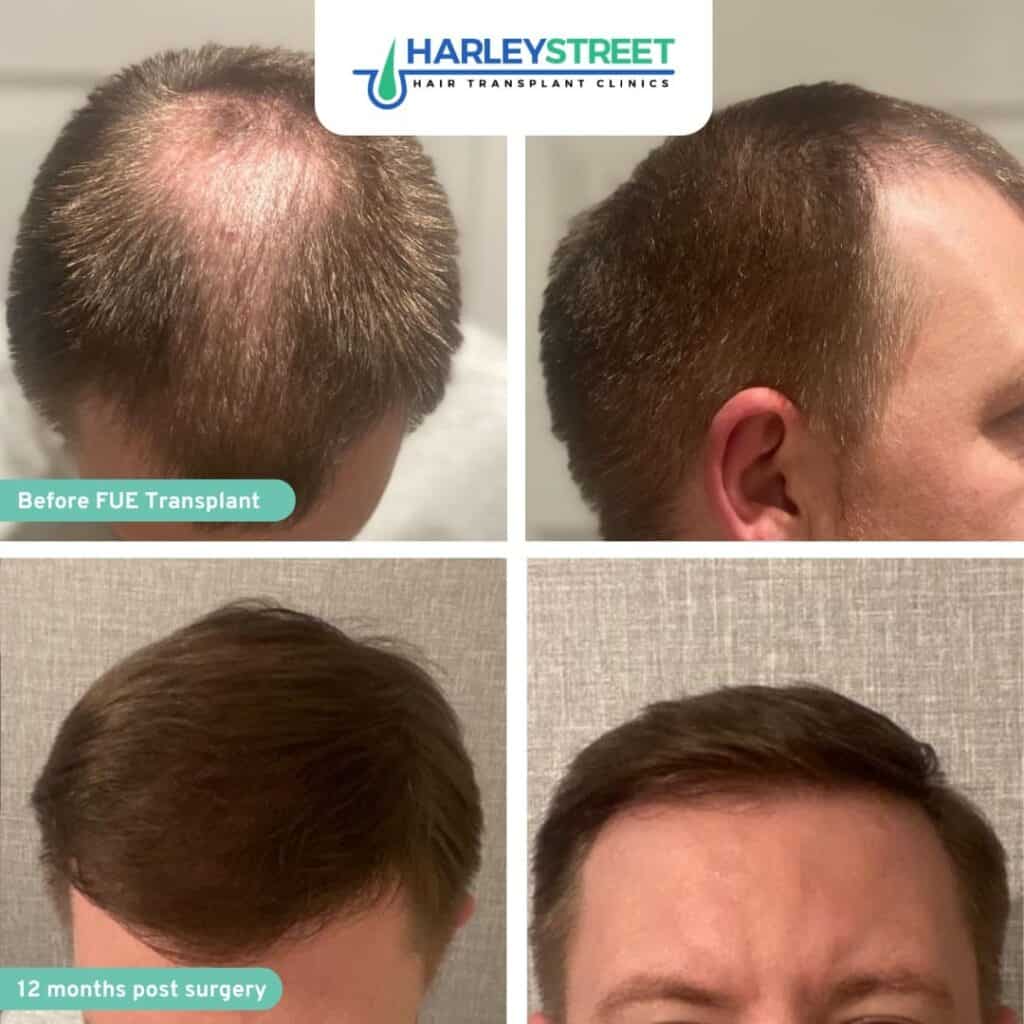
Before surgery, patients typically present with visible thinning or baldness on the top of the head, ranging from a small bald patch to extensive coverage loss. After a successful crown transplant, the area fills in with natural hair that matches the texture, direction, and colour of the surrounding hair. Full results are visible at around 12 months. You can view real patient before and after results at your free consultation.
Patient Testimonials
Aside from achieving fantastic results, we believe that keeping in touch with our patients before, during and after their hair transplantation procedure is paramount – it helps to keep our patients feeling calm and in control. We’re always on hand to provide guidance, support and aftercare advice. Time and again, our patients tell us that this is what sets us apart from other clinics.
You can read our great reviews of FUE hair transplants over on Google and Trustpilot


