






Every procedure at our Manchester clinic is performed by a GMC-registered surgeon
Based in central Manchester and easily accessible from across the North West
An honest assessment of your hair loss and what is realistically achievable, no obligation to proceed
Our surgeons treat one patient per day so every extraction and placement receives their full attention
Causes of Hair Loss for Women

It is natural for women to lose around 100 hairs every day, but excessive loss of hair, especially in women, can be a symptom of an underlying problem in the body. Female Pattern Baldness, Telogen Effluvium, Anagen Effluvium, Alopecia Areata and Traction Alopecia are the most common types of hair loss in women and are a result of different underlying issues. In order to treat the issue of hair falling out, women need to know what is causing it.
- Female Pattern Baldness or Androgenetic alopecia is due to the actions of various hormones and especially dihydrotestosterone (DHT), a product of the male hormone testosterone. Normally, women do not possess the hormone in quantities large enough to create hair loss, however, menopause and sometimes heredity from either of the parents may lead to thinning hair on the scalp and bald patches. Hormonal changes also cause the same type of hair loss after pregnancy and when some types of ovarian cysts occur.
- Telogen Effluvium, is also associated with hormones and especially with DHT. It is a short term reaction to a stressful event for the female body. This could be excessive dieting, child birth or extreme stress. Six weeks to three months after the event, hair loss occurs. Usually, the hair grows back even if not treated.
- Anagen Effluvium is hair loss because of chemotherapy. Chemotherapy targets rapidly dividing cells in the body, in order to destroy cancer cells. Because hair has the same quality, sometimes it is affected as well.
- Alopecia Areata is an autoimmune disease, which attacks hair follicles in the scalp area. This is also usually a hereditary disease.
- Traction Alopecia is the condition caused by the mistreating of hair with tight hairstyles, extensions and styling products.
Can Women Have a Hair Transplant?
Yes — women are suitable candidates for a hair transplant, though the criteria differ from men. The key requirement is a stable area of healthy donor hair, typically at the back and sides of the scalp. Women with female pattern hair loss often retain density in this zone, making them good candidates.
However, because female hair loss tends to be diffuse — spreading across the whole scalp rather than receding from a defined area — a thorough assessment is essential before surgery. Women with diffuse unpatterned alopecia (DUPA), where the donor area is also thinning, may not be suitable for transplantation.
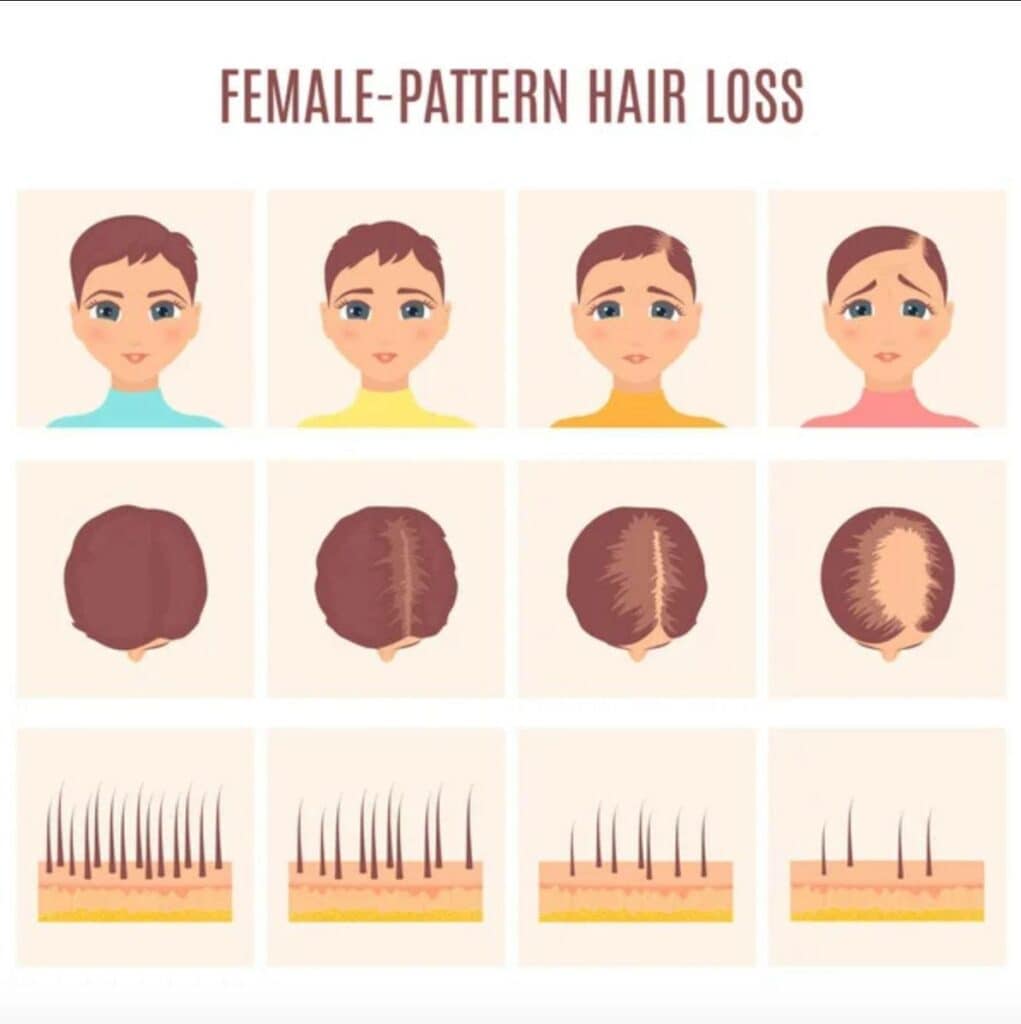
A useful reference for assessing female hair loss severity is the Ludwig Scale:
- Grade I: Mild thinning at the parting — often the earliest visible sign
- Grade II: Wider parting and increased thinning across the crown
- Grade III: Significant thinning across the top of the scalp with visible scalp
Women presenting at Grade I or II are typically the strongest candidates for surgical restoration. Our GMC-registered surgeons assess your Ludwig grade, donor density, and overall scalp health at your free consultation to determine the most appropriate course of action.
Hair Loss Factors in Women
There are countless factors why women may experience hair loss. Anything from clinical problems to hormonal changes to stress and anxiety. It’s difficult to try and diagnose the root cause.
Here are some of the reasons why women experience hair loss:
- Age.
- Genetics.
- Radiation medication.
- Medical problems.
- Extreme hairstyling (hair shade, horse tails, braids).
- Usage of destructive chemicals on hair.
- Stress.
- Menopause.
Menopause and Hair Loss
Hormonal changes during the perimenopause and menopause are one of the most common triggers of hair thinning in women over 40. The decline in oestrogen and progesterone — hormones that support hair growth — combined with a relative increase in androgens, can accelerate hair miniaturisation and shedding.
This type of hair loss is distinct in its onset and pattern and deserves dedicated attention. For a full guide to the causes, symptoms, and treatment options specific to this stage of life, visit our menopause hair loss page.
Hair Loss Treatments for Women
Because hair loss sometimes has to do with hair mistreatment, often women with thinning hair tend to dismiss the problem. In some cases that is the right thing to do. However, if the problem persists for more than a couple of months it is recommended to seek a doctor’s opinion on what is causing it and how to treat it.
There are various hair loss treatments for women on the market ranging from shampoos to FUE hair transplants. The treatment type of choice is dependent on the type of hair loss experienced, the type of treatment available, how effective it is going to be and budget.
The treatment that is usually suggested to most women is Minoxidil 2%. The treatment involves the application of the substance on the balding areas. Its results are not permanent and stop when the treatment is terminated. Common side-effects also include: burning or irritation of the eye, itching, redness or irritation at the treated area, as well as unwanted hair growth elsewhere on the body.
If hair loss is the result of malnutrition doctors may suggest taking iron supplements and when hormonal imbalance is to blame, spironolactone or oral contraceptives are prescribed.
In cases when hair loss is permanent, or a permanent solution to the hair loss problem is desired, hair transplants from healthy areas of the scalp can be used in order to cure hair loss in women.
Changing your hair regimen can only benefit your hair if the previous one was to blame for your hair loss. In that case it has been found that anti-dandruff shampoos that contain ketoconazole can slow it down.
To conclude, when facing persistent hair loss ask for your doctor’s advice and pick carefully your course of action. If your selected treatment is unsuccessful consult your doctor again because hair loss can be a sign of a vast number of undiscovered problems.
Hair Loss Treatment Options for Women at Manchester Clinic
Choosing the right treatment depends on the type and severity of your hair loss. The options below range from non-surgical management to permanent surgical restoration. A consultation with our team will help identify the most appropriate route for you.
- Minoxidil (topical): The most widely used non-surgical option for female pattern hair loss. Effective at slowing progression and stimulating regrowth in some patients, but results are not permanent and cease when treatment is stopped — as covered above
- PRP (Platelet-Rich Plasma) therapy: An in-clinic treatment that uses growth factors from your own blood to stimulate dormant follicles. Best suited to early-stage hair loss or as a complement to other treatments. See our dedicated PRP hair treatment page for full details
- FUE hair transplant: For women with stable, patterned hair loss and sufficient donor density, a FUE hair transplant offers a permanent solution. Individual follicles are extracted from the donor zone and implanted into thinning areas with precision
- Nutritional and medical management: Where hair loss is linked to iron deficiency, thyroid dysfunction, or hormonal imbalance, addressing the underlying cause through your GP or specialist is the essential first step
Frequently Asked Questions
The most common causes are female pattern baldness (androgenetic alopecia), telogen effluvium triggered by stress, illness, or hormonal changes, thyroid dysfunction, iron deficiency anaemia, and menopause. A correct diagnosis is essential before starting treatment, as the most effective option varies significantly depending on the underlying cause.
Female pattern baldness (androgenetic alopecia) is a progressive condition — without treatment, it typically worsens over time. It does not reverse on its own. However, treatments such as minoxidil can slow or stabilise the loss, and for suitable candidates, a hair transplant offers a permanent solution by restoring hair to thinning areas using follicles resistant to the hormonal process driving the loss.
Yes. Women can be excellent candidates for a hair transplant, provided they have a stable area of healthy donor hair and a patterned rather than diffuse form of hair loss. Our surgeons assess suitability at your free consultation, including a full evaluation of your scalp, hair loss pattern, and Ludwig grade.
There is no single best treatment — the right option depends on the cause, severity, and whether the hair loss is ongoing or stable. Minoxidil is the most widely prescribed non-surgical option. PRP therapy suits early-stage or diffuse loss. A hair transplant is the only permanent solution for patterned loss with adequate donor supply. Your consultation will identify the most appropriate route for your specific situation.
It depends on the cause. Telogen effluvium — triggered by stress, illness, or hormonal events — typically resolves on its own once the trigger is removed, with regrowth occurring within six to twelve months. Female pattern baldness does not regrow spontaneously and requires active treatment to halt or reverse. Hair lost due to traction alopecia may regrow if the damaging styling practices are stopped early enough, before permanent follicle damage occurs.
Patient Testimonials
Aside from achieving fantastic results, we believe that keeping in touch with our patients before, during and after their hair transplantation procedure is paramount – it helps to keep our patients feeling calm and in control. We’re always on hand to provide guidance, support and aftercare advice. Time and again, our patients tell us that this is what sets us apart from other clinics.
You can read our great reviews of FUE hair transplants over on Google and Trustpilot


