
Technique: Follicular Unit Transplant
Approach: Doctor-led Procedure
Surgeons: GMC, ISHRS Registered
Cost: £3,000 – £7,000
Grafts: Based on patient’s hair loss
FUT Hair Transplant





GMC-Registered Surgeons
Every procedure at our Manchester clinic is performed by a GMC-registered surgeon
Manchester City Centre
Based in central Manchester and easily accessible from across the North West
Free Consultation Available
An honest assessment of your hair loss and what is realistically achievable, no obligation to proceed
Quality Over Volume
Our surgeons treat one patient per day so every extraction and placement receives their full attention
FUT Hair Transplants in Manchester
The FUT hair transplant method is the first method ever used in the hair transplant industry. It involves taking a strip of skin from the donor area and using it to harvest DHT-resistant hairs that are subsequently used for implantation into the recipient area. It is a preferred method amongst women and transgender individuals as there is not donor area shaving required as there is with FUE.
What is a Follicular Unit Transplant?
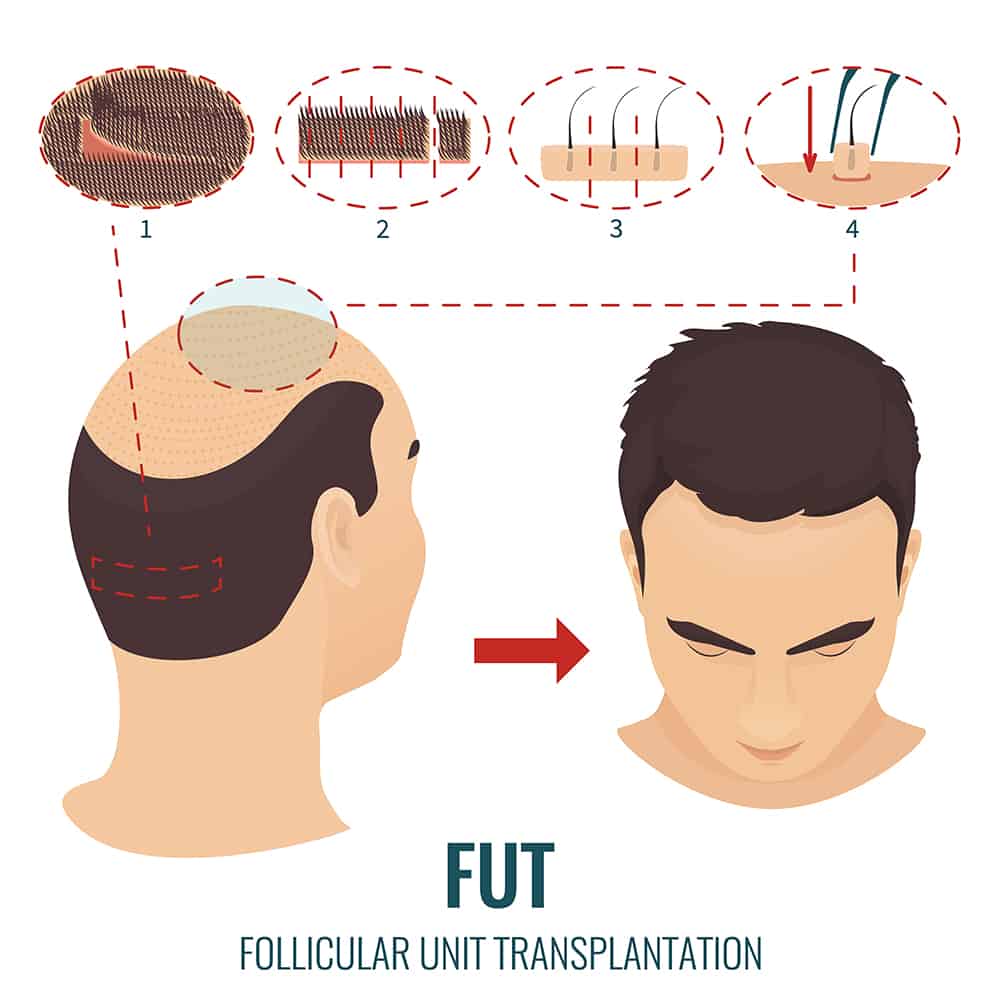
Follicular Unit Transplant (FUT) is also referred to as the strip method. This method involves cutting a linear strip of skin from the back of the head and dissecting it to harvest hair follicles for transplantation.
The FUT method is the old way of performing hair transplants as the large linear scar it leaves at the back of a patient’s head is undesirable.
It has been replaced mostly with the newer method called FUE hair transplant.
How Does FUT Surgery Work?
Hair is more resistant to balding on the back and sides of the scalp, so follicles are taken from here and transferred to the areas you need it. The hair taken to be grafted must be taken from areas where your hair is permanent and not subject to DHT.
The scalp first has an anaesthetic applied, after which a donor strip of tissue is taken from the scalp. This is then used to prepare grafts for the areas you would like to have hair. Tiny holes are made in the scalp as the grafts are being made. This is where you’ll have your grafts placed.
The arrangement of your grafts is really important, as this will determine the end look. However, this varies from patient to patient. You will have something designed for you based on your history of hair loss and how likely it is you will lose hair again in the future.
The most important part of designing your new look is deciding on the number of grafts you will have placed on your head. This will give maximum aesthetic effect when done correctly. If more than one session should be needed, this will be discussed with you during a consultation. The issue with FUT surgery is that you can get a horizontal scar on your scalp from the donor strip that was cut out.
How Much Does FUT Surgery Cost?
FUT hair transplant surgery costs a bit more than FUE and the main components why are:
- More staff costs – FUT requires extra members of the team in order to cut and slither the grafts from the strip of skin.
- More expensive equipment – Latest state of the art microscopes are required for the team to be able to work on the grafts from the strip of skin.
Because of these main 2 attributes, FUT hair transplants tend to cost around £1,000 more than FUE hair transplants. Full pricing details are available on our hair transplant cost page. Your patient advisor will provide a personalised quote following your free consultation
FUT vs FUE: Which Method Is Right for You?
Both FUT and FUE hair transplant achieve the same goal — permanent hair restoration using your own DHT-resistant donor follicles. The key difference lies in how those follicles are harvested.
FUE extracts follicles individually from the donor area using a small punch tool. The donor area must be shaved for this process, and it leaves no linear scar — only tiny, near-invisible dot marks that heal quickly.
FUT removes a strip of skin from the donor area, from which follicles are dissected under microscope. Crucially, the donor area does not need to be shaved — making FUT the preferred option for patients who wish to keep their hair long throughout their recovery.
The trade-off with FUT is a linear scar along the back of the scalp where the strip was removed. For patients who wear their hair longer, this is easily concealed. For those who prefer very short hair at the back, FUE is the better choice.
At the Manchester clinic, FUT is most commonly chosen by women and transgender patients who do not wish to have their donor area shaved as part of the procedure. Our surgeons will advise which method is most appropriate for your hair loss pattern and lifestyle at your free consultation.
Who Is FUT Best Suited For?
FUT is a highly effective procedure, but it suits a specific profile of patient. It is most appropriate for:
- Women: FUT is the preferred surgical method for female patients who do not wish to shave their donor area. The strip method allows the surrounding hair to remain long throughout surgery and recovery, keeping the procedure discreet
- Transgender patients: For the same reason, FUT is commonly chosen by transgender patients who wish to maintain longer hair throughout their recovery
- Patients requiring large graft sessions: The donor strip can yield a high number of grafts in a single pass, making FUT well suited to patients requiring larger session volumes
- Patients comfortable with a linear scar: The strip removal leaves a horizontal scar at the back of the scalp. For patients who wear their hair at a medium or longer length, this is easily concealed
FUT is not recommended for patients who prefer to wear their hair very short at the back, as the linear scar may be visible at shorter lengths. In those cases, FUE or DHI is the more appropriate choice.
FUT Hair Transplant Recovery Timeline
FUT recovery differs slightly from FUE due to the strip excision at the donor site. The wound is closed with sutures, which require removal after 10–14 days. Here is what to expect:
- Days 1–3: Tightness and mild discomfort at the donor site are normal. Redness and minor swelling around the recipient area settles quickly
- Days 10–14: Sutures are removed at the clinic. The donor scar begins to flatten and fade
- Weeks 2–4: Transplanted hairs shed — expected and does not indicate failure
- Months 2–4: Shedding ends; new growth begins to emerge from the implanted follicles
- Months 4–8: Visible regrowth accelerates; hair thickens and texture normalises
- Months 12–18: Full results visible — transplanted hair is permanent and grows as your own

Frequently Asked Questions
FUT removes a strip of skin from the donor area, from which follicles are dissected and implanted. The donor area does not need to be shaved, but a linear scar is left at the back of the scalp. FUE extracts follicles individually — no linear scar, but the donor area must be shaved. The right choice depends on your hair length preference and lifestyle.
Yes — FUT leaves a linear scar along the back of the scalp where the donor strip was removed. For most patients who wear their hair at a medium or longer length, this is easily concealed beneath existing hair. The scar fades and flattens over time. Patients who prefer very short hair at the back may find FUE a more suitable option.
FUT is often the preferred method for female patients because the donor area does not need to be shaved. This allows patients to keep their hair long throughout surgery and recovery, keeping the procedure discreet. For women with shorter hair or who are concerned about scarring, FUE or DHI may be more appropriate — your surgeon will advise at consultation.
FUT costs approximately £1,000 more than the equivalent FUE procedure due to the additional staffing and specialist equipment required to dissect grafts from the donor strip. Full pricing is available on our hair transplant cost page. Your patient advisor will provide a personalised quote following your free consultation.
Sutures from the donor site are removed at 10–14 days. Most patients return to desk-based work within a week. Transplanted hairs shed in weeks 2–4 — this is normal. New growth appears from months 2–4, with full results typically visible at 12–18 months.
Patient Testimonials
Aside from achieving fantastic results, we believe that keeping in touch with our patients before, during and after their hair transplantation procedure is paramount – it helps to keep our patients feeling calm and in control. We’re always on hand to provide guidance, support and aftercare advice. Time and again, our patients tell us that this is what sets us apart from other clinics.
You can read our great reviews of FUE hair transplants over on Google and Trustpilot