




What is the Follicular Unit Extraction Method?
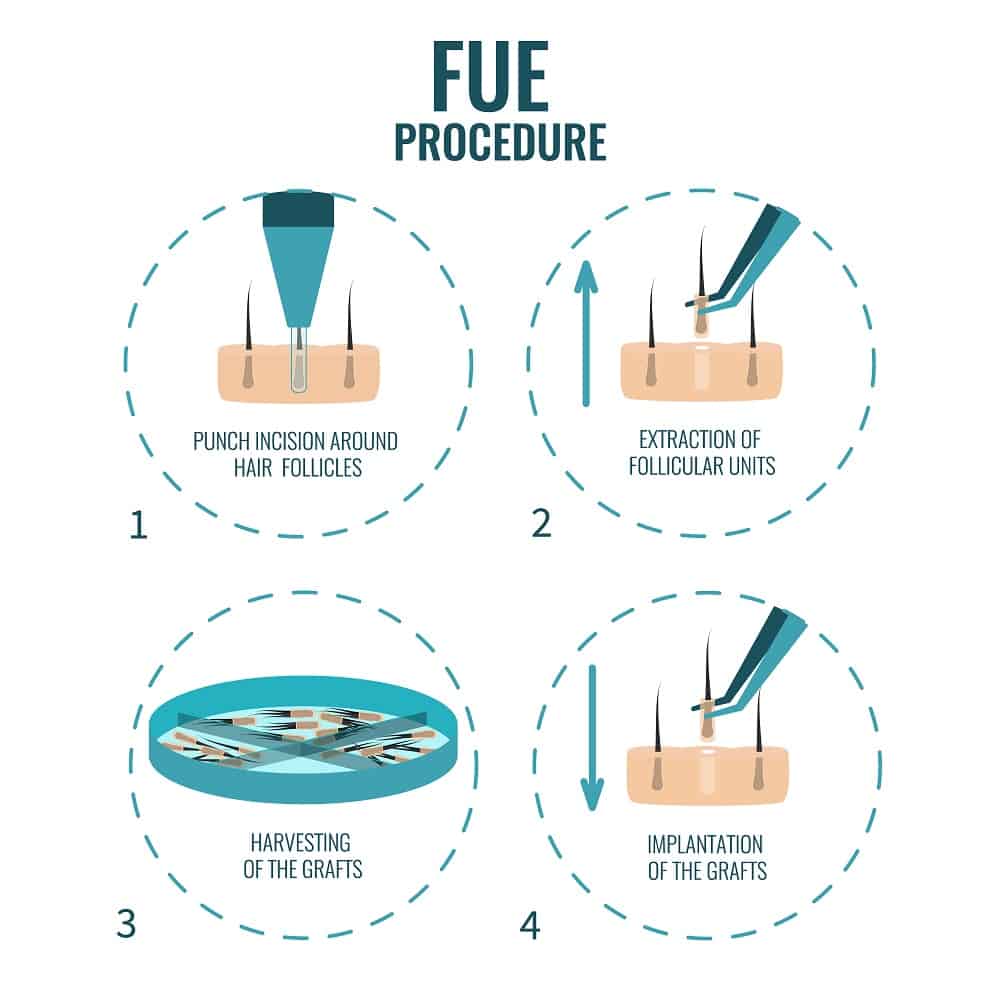
Follicular Unit Extraction (FUE) represents a modern advancement in the traditional Follicular Unit Transplantation (FUT) technique, maintaining consistent follicular unit implantation into the recipient area to ensure a natural transplant growth without the appearance of “plugginess.”
The key distinction lies in the method of harvesting hair from the donor area. Unlike FUT, which involves excising a strip of hair, suturing the area, and dissecting follicular units under a microscope, FUE individually removes follicular units one by one. As a result, no suturing of wounds is required, and microscopic dissection becomes unnecessary.
The FUE procedure involves using a 0.8mm – 1 mm punch around a single follicular unit to create a small circular incision through the skin. The follicular unit is gently extracted from the loose connective tissue beneath the skin. Once removed, no additional preparation is needed, and the small hole naturally heals over one to two weeks. This process is repeated multiple times until the desired number of follicular units are obtained, leaving the patient with numerous 0.8mm – 1 mm round white scars, rather than the linear scar associated with FUT.
Supporters of FUE highlight less noticeable scarring and the absence of scalp tightness, a common issue in FUT due to tissue suturing. However, FUE comes with notable drawbacks, including the challenge of efficiently performing large sessions. The slow and meticulous nature of extractions may require multiple-day sessions for patients seeking significant coverage.
A theoretical concern with FUE is its potential impact on long-term growth. During extractions, follicular units are gently torn from underlying tissues, and the absence of the deepest component of connective tissue beneath the follicles may lead to weakening over time. The novelty of this technique makes long-term outcomes uncertain.
Patients must also acknowledge that scarring is inevitable in the donor area, albeit in a different form. FUE results in numerous tiny round scars, which may be preferable or not, depending on specific patient characteristics such as scalp tightness, scarring tendencies, and hair loss patterns.
In conclusion, while FUT has historically served its purpose, both the Direct Hair Implantation (DHI) technique and FUE offer superior results at a similar cost. Therefore, patients can receive more effective treatment and better outcomes with these advanced techniques.
The Four Stages of a FUE Hair transplant
Before an FUE hair transplantation, local anaesthetic is administered, so you won’t feel more than a slight pressure during the procedure
- A Micro Punch tool is used to cut a small circle of skin around the individual follicular unit
- The follicular unit (or graft) is gently prised away from the surrounding loose connective tissue under the skin
- The harvested grafts are sorted according to how many individual hairs in each follicle
- The grafts are then implanted into the balding area of the scalp
What is the difference between FUE and FUT?
There are a number of key differences between the FUT and FUE hair transplant methods.
Often called the ‘strip method’ or ‘strip surgery’, FUT hair transplants take large strips of donor hairs from the patient’s scalp. These strips of hair are then dissected under a microscope before being implanted into the balding area. In comparison, follicular unit excision (FUE) takes much smaller hair grafts from the donor area, not only making it quicker, but leaving most patients with much less scarring than those who have undergone FUT.
Why choose FUE over FUT?
- During procedure, there is less pain involved in FUE than FUT. This is because no major, or large, incisions are required.
- FUE is also a quicker than FUT. This is because no separations need to be made under a microscope as is needed with FUT. This means you can tailor your hair transplant around your busy schedule!
- After the procedure, FUE typically has a much quicker recovery time when compared to FUT. This is because of the reduced scarring made by the 1mm punches. Patients are left with tiny scabs that quickly heal as opposed to large incisions made in the scalp.
Patient Testimonials
Aside from achieving fantastic results, we believe that keeping in touch with our patients before, during and after their hair transplantation procedure is paramount – it helps to keep our patients feeling calm and in control. We’re always on hand to provide guidance, support and aftercare advice. Time and again, our patients tell us that this is what sets us apart from other clinics.
You can read our great reviews of FUE hair transplants over on Google and TrustPilot
 WatchTheHorison30/08/2023Welcoming staff. Nurse and doctor was lovely. No issues parking and coffee while you wait.
 Mazza Ellerton23/08/2023Great experience. Made to feel really comfortable throughout the whole day and would highly recommend
 Tom Francis23/08/2023If you are thinking about it - go for it! Looked after, day went smoothly and worth it - let’s wait and see for the progress.
 Louis Robson08/06/2023Great service and advice would dr Mumir was brilliant and full of great advice
 John P Ronan30/03/2022Very few can deliver a professional service whilst ensuring that all clients receive first -class personalised treatment, turning what can be a daunting experience into something of relative ease. Both Kevin, Dr Karla, and their surgical team certainly did this (and then some!) Once my mind was made up to have hair loss treatment, I was keen to get my transplant done asap. Kevin exceeded all my expectations with this - it’s hard to believe that my journey from first consultation to surgery happened in the space of one month. Efficiency did not stop there - on the day of surgery, my transplant was completed in less than 6 hours, all the while ensuring that I was comfortable and pain-free. Security is the best word that comes to mind to describe Dr Karla’s care -you know you’re in experienced hands! Now I can look forward to the results over the next few months, with the added peace of mind that the Harley Street Clinic team are only a phone call or email away to address any concerns. They will be the first name I will recommend to anyone looking for effective hair loss treatment, and I hope to make use of their service again in the future should I need it.
 Matty B01/03/2022I got a hair transplant and PRP for my hair. Im 19 years old and it’s the best decision I made so far. Manchester hair transplant clinic have been amazing. They were brilliant at welcoming me into getting a hair transplant and amazing at doing the job right. I will defiantly be going to them later on in my life if/when another is needed due to my age. I would highly recommend their service to anyone interested 😊
 Bharat Bapodra10/02/2022I was quite scared before going into surgery, but Dr kalra reassured me the procedures were straight forward and easy going. And he was amazing and so were the team. Everyone was polite and professional and I will recommend this team to anybody else :)
 Rhys Jones24/01/2022Great experience, Kevin walked me through every step of the process beforehand and helped with any questions I had along the way. Dr. Kalra and the team looked after me on the day which went great. Thanks guys for your help, amazing experience.
 Martin Nikolli21/01/2022Was good job from Dr Kalra and the staff were very nice This experience was better than i was thinking about hair transplant And thanks to Kevin 👍
